Write content that can be cited
State the answer, identify its source, and include the limits that make the claim accurate. Use a Blockquote audit to choose an applicable repair, then verify what changed on the delivered page.
Blockquote's developer documentation groups its checks into schema, structure and citability. Its score describes checks on the fetched page. It does not measure whether a search engine indexed the page or an AI answer cited it.
Write an answer that keeps its context
Start with the reader's question. Name the subject instead of relying on “it” or “this” when a passage might be read separately. Put the important constraint beside the answer, rather than several sections later.
For example, a finding about an article's author should name the article, the missing field and the evidence received. “Improve your authority” gives the reader no repair to verify.
Use headings to divide distinct questions. Use a list for steps and a table for comparable facts. Add detail when it answers the question; repeated conclusions and decorative formatting add little useful evidence.
Put sources beside the claims they support
Link the original documentation, measurement or research near the relevant claim. State the version, date or population when it changes the meaning. Distinguish something you measured from an explanation you infer.
An external-link count cannot establish that the linked sources are reliable or support the sentence. A word-count threshold cannot establish that the answer is complete. Review both the evidence and the prose instead of adding material solely to improve a counter.
The check catalog explains what each check measures and how to repair a failure. Pass thresholds belong to the implementations and can change as the rubric is calibrated. Use the catalog to understand a finding's scope.
Choose markup that fits the page
Structured data describes the visible content. Google's structured-data guidelines require that description to be relevant and accurate. Valid syntax alone cannot establish this.
An article can use Article, NewsArticle or BlogPosting. A pricing page does not become an article because an audit includes an Article check. Blockquote marks that check N/A when its classifier identifies the page as something other than content. N/A is an applicability decision, not a passed check.
If the classification looks wrong, inspect the returned page and the finding's evidence before changing markup. Do not invent an author, organization or publication date to satisfy a recommendation.
Google's Article documentation defines datePublished as first publication and dateModified as the latest article modification. A rescan does not itself change either event. Preserve known dates and leave unknown facts unresolved.
A concrete specimen: this guide's existing page
On 11 October 2026, a manual inspection of the public LLM-friendly guide found these matching assertions:
- Heading: “Write content that can be cited” matches the structured-data headline.
- Byline: “By Arne Kellmann” matches author.name, Arne Kellmann.
- Update date: “Updated 2026-10-07” matches dateModified, 2026-10-07.
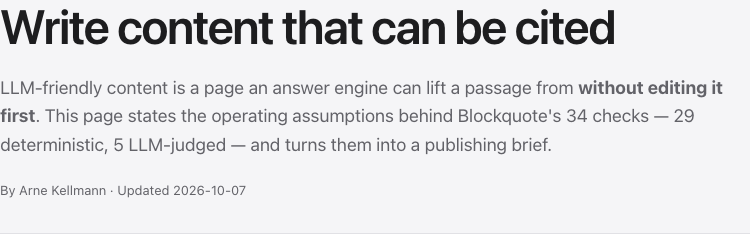
This inspection checks agreement between the page and its markup. It does not independently establish publication history, and it is not a Blockquote scan result.
Use the same comparison after a repair. Read the visible byline and dates, then inspect the delivered markup. A generated Article snippet can contain “Author Name” and “YYYY-MM-DD”. Replace placeholders with verified facts before publication. Check the related findings too; one presence check cannot establish every value's truth.
Verify a repair against comparable evidence
Keep a before-and-after record for the exact page:
- Keep both original reports, including scan times, requested and final URLs, report versions, coverage flags and relevant finding evidence.
- Check whether the fetched content is complete and represents the intended page.
- Make the applicable repair using verified values.
- Publish through your site's normal release process, then inspect the delivered text and markup.
- Rescan and compare the affected check, its evidence and any regressions.
A truncated fetch can produce a partial scan. Blockquote leaves passing and already-N/A checks unchanged. Other failed checks become N/A and lose their fixes, except the direct-answer and definition-opener checks. A score difference can therefore reflect changed coverage. Read the original coverage fields before attributing it to a repair.
Blockquote withholds numeric comparison deltas when report schema versions differ. Matching versions alone do not establish comparable coverage or page content. Check the final destination, scan tier, page classification and received content yourself. The comparison summary omits some original-report fields, including partial status and scan tier. A redirect or different page response can change what was measured.
Record a narrow result, such as “the delivered author field now matches the visible byline”. Only report a changed check result when the corresponding rescan actually returned it.
Keep search eligibility and observed citations separate
Google says a supporting link in AI Overviews or AI Mode must be indexed and eligible for a Search snippet. Its AI-feature guidance adds no special technical requirements, AI text files or special schema for those features. This guidance concerns Google Search, not every AI service.
Make important information available as text, link to it from relevant pages, and allow the intended crawler to reach the public content.
- Delivered HTML contains the corrected field: that response contains the repair.
- A comparable rescan returns a changed finding: that check changed under the recorded conditions.
- Search Console reports the URL as indexed: Google recorded that indexing state at that time.
- A saved AI answer links to the page: a citation was observed for that answer, query and time.
An observed citation does not establish that a particular repair caused it. A higher audit score cannot substitute for the last two observations.
Choose the next repair from the report's evidence and the page's purpose. Use the scan form when you need a new report. Keep unknown outcomes unknown.
Sources and scope
Google Search Central: AI features and your website. Search eligibility and Google-specific technical requirements.
Google Search Central: General structured data guidelines. Visible relevance, factual accuracy and validator limits.
Google Search Central: Article structured data. Article properties, authors and dates.
Blockquote check catalog, developer documentation and audit scope and comparison limits. Check purposes, score categories and the limits of comparisons.
Google sources and the public specimen were checked 11 October 2026. Product documentation was rechecked 12 October 2026.
Sources
- AI features and your website. Checked .
- General structured data guidelines. Checked .
- Article structured data. Checked .
- Blockquote audit scope and report comparison. Checked .
- Blockquote check catalog. Checked .
- Blockquote developer documentation. Checked .
- Existing Blockquote guide opening, captured 11 October 2026. Checked .